


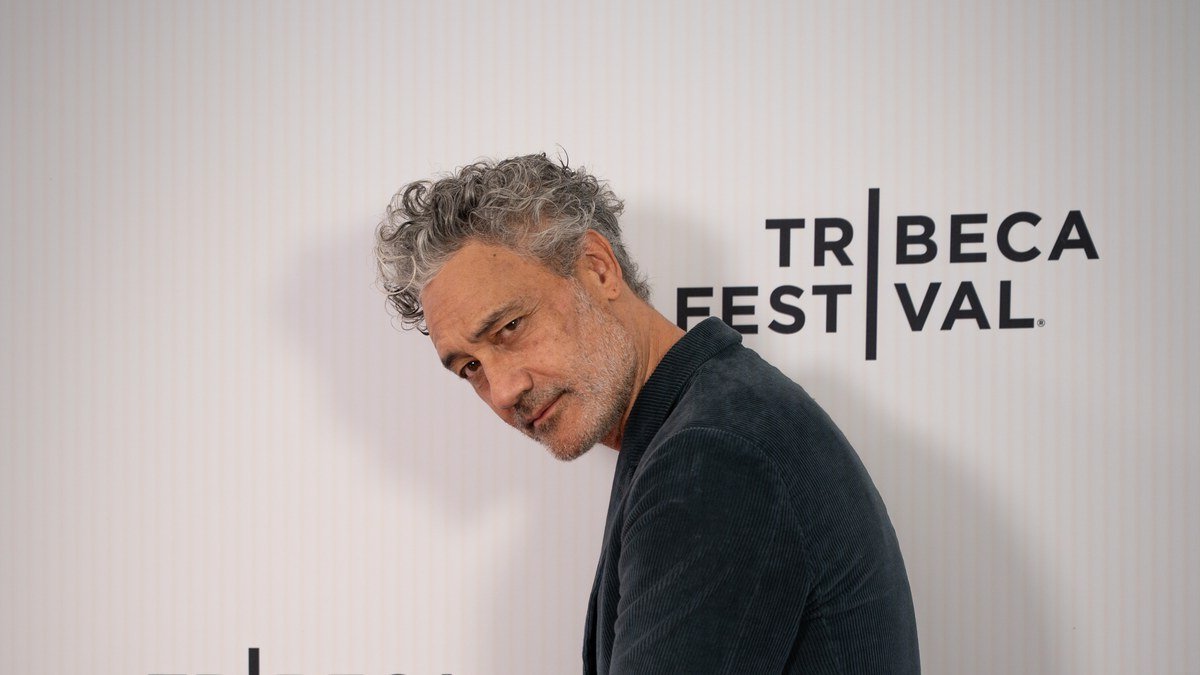
Taika Waititi has a habit of casting himself in his own films — a 379-year-old vampire, an imaginary Adolf Hitler, a rock monster with a Kiwi accent. So fans were surprised to learn that in his latest film, an adaptation of Kazuo Ishiguro’s novel Klara and the Sun, which arrives in cinemas today, the New Zealander is nowhere to be found.
Speaking exclusively to Radio Times at the London Film Festival ahead of the film’s release this weekend, Taika Waititi revealed that this was never the plan.
“I actually did write – and we shot some scenes – with a very different thing that wasn’t in the book, where Klara meets this group of rogue robots who’ve all been rejected and formed their own society,” he said. Waititi himself played the leader of the pack. “It was my little group of robots, and I was like, ‘This is the Taika time. This is going to be so good!'”
The scenes didn’t survive the edit, but the idea lives on: Waititi told Radio Times he plans to turn the deleted storyline into a television series about the rogue robots. So who is the Oscar-winning filmmaker who cut himself out of his own film — and what made Taika Waititi one of the most distinctive directors of his generation?
A Childhood Between Two Worlds
Taika Waititi was born Taika David Cohen on 16 August 1975 in Wellington, New Zealand. His father was an artist of Māori and French Canadian descent, from the Te Whānau-ā-Apanui iwi; his mother, Robin Cohen, was a schoolteacher of Russian Jewish, Irish and other European descent. Waititi identifies as both Māori and Jewish, describing himself as a “Polynesian Jew”.
His parents divorced when he was around five, and he was raised primarily by his mother, spending time between Wellington’s Aro Valley suburb and Raukokore, a small town in the Bay of Plenty on New Zealand’s East Coast. It was a childhood split between the capital’s bohemian inner suburbs and a remote coastal community where his father’s family came from — two worlds that would later feed directly into his films, with their mix of deadpan city humour and rural heart.
The Grandfather Who Went to War
His paternal grandfather, also named Taika, served as a Māori Battalion soldier during the Second World War — a piece of family history that echoes through Jojo Rabbit, his satire of Nazi Germany. Although his surname is legally Cohen, Waititi has gone by his father’s surname for most of his life — he used Cohen for early film and writing work and Waititi for visual arts, before settling on Waititi professionally after the success of his first short film.
He attended Onslow College in Wellington, then studied theatre at Victoria University of Wellington, graduating with a Bachelor of Arts in 1997. It was at university that Taika Waititi found his tribe — and his trade.
Comedy Beginnings and an Oscar Nomination
At university, Waititi threw himself into comedy. He joined the five-man ensemble So You’re a Man, which toured New Zealand and Australia, then formed the stand-up duo The Humourbeasts with Jemaine Clement — a partnership that won the 1999 Billy T Comedy Award, New Zealand’s top honour for emerging comedy talent. The stand-up-to-screen route is a familiar one for comic performers — FamePost’s profile of James Acaster traces a similar path — but few have travelled it as far as Waititi.
Two Cars, One Night
His move into filmmaking was swift and striking. His second short film, Two Cars, One Night (2004), a tender fable about two boys and a girl waiting in a rural pub car park, was nominated for the Academy Award for Best Live Action Short Film. That nomination, at the age of 28, put Taika Waititi on the international map.
The feature that followed was the oddball romantic comedy Eagle vs Shark (2007), co-written with Loren Horsley. He also wrote and directed episodes of Clement’s series Flight of the Conchords, learning how to shoot comedy quickly and cheaply — skills that would define his working method for the next two decades.
The New Zealand Breakthrough
If Hollywood eventually came calling, it was because of three films Taika Waititi made at home — each of which, in its own way, rewrote the record books for New Zealand cinema.
Boy and the Box Office Records
Boy (2010), a bittersweet coming-of-age story set in 1980s New Zealand, premiered at the Sundance Film Festival and confirmed him as his country’s most exciting young director. Waititi also played one of the main roles, as the ex-con father who returns to his family. On release, Boy eclipsed local box office records, and both it and Hunt for the Wilderpeople have each been the top-grossing film entirely funded and produced within New Zealand.
What We Do in the Shadows
He then co-directed the vampire mockumentary What We Do in the Shadows (2014) with Clement — playing the foppish Viago von Dorna Schmarten Scheden Heimburg — after it premiered at Sundance in January 2014. The film’s flat-sharing vampires became a cult phenomenon, and the American television adaptation that followed in 2019, with Waititi as executive producer, was nominated for the Emmy for Outstanding Comedy Series.
Hunt for the Wilderpeople
Hunt for the Wilderpeople (2016), the anarchic chase comedy starring Sam Neill and Julian Dennison, was adapted from Barry Crump’s novel Wild Pork and Watercress. It broke Waititi’s own record for a New Zealand film in its opening weekend, went on to take more than NZ$12 million at home — unseating Boy as the country’s highest-grossing local production — and earned around $23.9 million worldwide. Empire magazine named it the best film of 2016. The same year, Taika Waititi also wrote the initial screenplay for Disney’s Moana, though his draft’s focus on gender and family was passed over in favour of the final story.
Taika Waititi in Hollywood: Thor and the Oscar
Marvel came calling in 2017. Before the feature, Waititi had warmed up with the Team Thor short films, mockumentary sketches about Thor’s life with his flatmate Darryl. Then Thor: Ragnarok took a flagging franchise and detonated it with colour, comedy and an 80s rock sensibility — and introduced Korg, the laconic rock creature Waititi voiced and motion-captured, speaking in what Waititi himself has described as the voice of an uncle from his own neighbourhood. The film was a critical and commercial triumph: it finished 2017 as the highest-grossing release of the year in his native New Zealand, and its success was such that Marvel’s writers consulted Waititi on Thor’s storylines in Avengers: Infinity War to keep the character consistent.
Jojo Rabbit: Playing Hitler, Winning an Oscar
Then came Jojo Rabbit (2019), a film nobody else would have dared make: a satire, based on Christine Leunens’ novel Caging Skies, about a boy in Nazi Germany whose imaginary friend is Adolf Hitler, played by Waititi himself. The film received six Academy Award nominations, including Best Picture, and Taika Waititi won the Academy Award for Best Adapted Screenplay — making him the first person of Māori descent to win an Oscar, and the first indigenous person to be nominated for and win in that category. It also won the BAFTA in the same category, and in 2021 he collected a Grammy Award as a producer of the film’s soundtrack.
Love and Thunder and Life on Screen
The victory cemented a signature style: improvisation-heavy sets, humour deployed as a Trojan horse for genuine emotion, and a refusal to treat genre as a straitjacket. His acting appearances multiplied — voicing IG-11 in The Mandalorian (for which he earned an Emmy nomination for voice-over performance, and he also directed the first season’s finale), returning to Marvel for Thor: Love and Thunder (2022), where Christian Bale joined the cast as the villain Gorr, and executive-producing the FX comedies Reservation Dogs — co-created with Sterlin Harjo and built around indigenous Oklahoma teenagers — and the television version of What We Do in the Shadows. There were also cameos as the original Ratcatcher in The Suicide Squad, as the villain Antwan in Free Guy, and as the voice of Mo Morrison in Pixar’s Lightyear.
While editing Thor: Love and Thunder, he was simultaneously playing the pirate Blackbeard in the HBO Max comedy series Our Flag Means Death — a role the show’s creator, David Jenkins, had written with him in mind. “I was Blackbeard by day and then was editing Thor by night,” Waititi recalled, calling the overlap “a management nightmare” but also “one of my favorite roles that I’ve played,” because for once he didn’t have to write it.
The Thor shoot also showcased the working method his collaborators keep describing: Natalie Portman said Waititi was “pretty gutsy about just letting us seriously change the plot because of certain choices we made in the scene,” allowing actors latitude in both the comedic and emotional material. It is the same improvisation-first ethos that made his sets famous — throw the script away, shout ideas from behind the monitor, and find the film in the moment. Love and Thunder drew a more mixed response than its predecessor, but by then Taika Waititi was, by any measure, one of the most in-demand filmmakers alive: in 2017 he had been named New Zealander of the Year, and in 2022 Time magazine placed him on its list of the 100 most influential people in the world.
Klara and the Sun: A Deliberate Change of Pace
His adaptation of Ishiguro’s 2021 dystopian novel is a deliberate gear change. The book follows Klara, an “artificial friend” built to provide companionship, as she navigates a hazardous human world — a story with little of the broad comedy Waititi is known for. The film premiered at the 70th BFI London Film Festival on 15 October 2026 and is released in UK and US cinemas on 23 October by Sony Pictures, with Ishiguro himself serving as an executive producer. Waititi has said the central challenge was bringing his own tone without disturbing the novel’s quiet, beautiful rhythm, telling Variety Australia: “I wanted to make sure that I brought my own tone that I usually do to my films into this, but I didn’t want to mess too much with the actual sort of overall time of how the book reads.”
He found Ishiguro’s novel at an airport and resolved to adapt it on the spot. “I knew I was never going to be doing that,” he said of the temptation to turn it into a conventional AI-threat blockbuster — in his version, Klara is, in his words, “a dumb robot” with a sweet, simple purpose.
The Cast of Klara and the Sun
Jenna Ortega stars as Klara, the solar-powered artificial friend at the story’s heart. Amy Adams plays Chrissie, the mother of Josie, the sickly teenager who chooses Klara from the shop window; Josie is played by Mia Tharia. Aran Murphy — the son of Oscar winner Cillian Murphy — plays Rick, Josie’s best friend, while Natasha Lyonne is the store manager who sells Klara, Steve Buscemi appears as the benefactor Capaldi, and Rachel House, a veteran of Waititi’s New Zealand films, plays the housekeeper Melania. Simon Baker was cast as Josie’s father, but his scenes were cut from the finished film — in good company, given what happened to the director’s own.
Made in New Zealand
Taika Waititi brought the production home. Filming began in January 2024 under the working title Tears and Rain, with scenes shot at Silverlight Studios in Wānaka and in Auckland. The screenplay was written by Waititi with Dahvi Waller, the producer is David Heyman — the man behind the Harry Potter films and Barbie — and the score is by Michael Giacchino, his fourth collaboration with Waititi after Jojo Rabbit, Thor: Love and Thunder and Next Goal Wins. The finished film runs 116 minutes. Early reviews have been divided and, in several quarters, severe — a reminder that the quiet melancholy of Ishiguro was always going to be the sternest test of the Waititi method.
There is something fitting about the film’s release coinciding with Waititi’s confession about the deleted scenes. In an earlier interview with The Creative Independent, he once joked that he is “the first person who will suggest cutting all of my stuff out of the movie,” adding: “I’m not precious at all about the stuff I do.” The rogue-robot leader he shot and then discarded may yet return on television — proof, if it were needed, that with Taika Waititi, nothing is ever really thrown away.
Personal Life: Family and Marriage to Rita Ora
Waititi keeps his private life relatively guarded. He has two daughters from his first marriage, to New Zealand film producer Chelsea Winstanley, whom he married in 2011 and divorced in 2018. He has been in a relationship with the British singer Rita Ora since 2021, and the couple married in August 2022.
The marriage produced one of his most charming recent television moments: in 2025, Taika Waititi appeared in the thirteenth series of The Masked Singer as Detective Lucky Duck — and was revealed in the semi-finals, to the surprise of Ora, who was sitting on the panel.
What’s Next for Taika Waititi
One of the longest-running stories of Waititi’s career has been the Star Wars film announced in 2020. During the Klara and the Sun press rounds this week, he finally put the question to rest, telling Inverse that the project is being shelved indefinitely: “I hate to break this to you, but we’re going to actually put it on ice,” he said, adding, “It’s very iced. I’ve got about four other movies I’m trying to do.”
Those projects, he said, include a Charlie and the Chocolate Factory film, We’re Wolves — a sequel to What We Do in the Shadows — an adaptation of the graphic novel The Incal, and a film called Barn 8, alongside his collaboration with Poor Things writer Tony McNamara on a separate project. The Chocolate Factory project has since taken shape: in April 2026, Netflix announced an animated follow-up, Charlie vs. The Chocolate Factory, in which Waititi will voice Willy Wonka and serve as executive producer. He also found time to direct a Pepsi commercial that aired during Super Bowl LX in February 2026, cameoing in it as a polar bear’s therapist.
Between the deleted robots, the shelved Star Wars film and the Wonka voice role, Taika Waititi remains what he has been since Boy: a filmmaker who treats every genre as raw material, every set as a playground, and every one of his own scenes as cheerfully expendable.
