


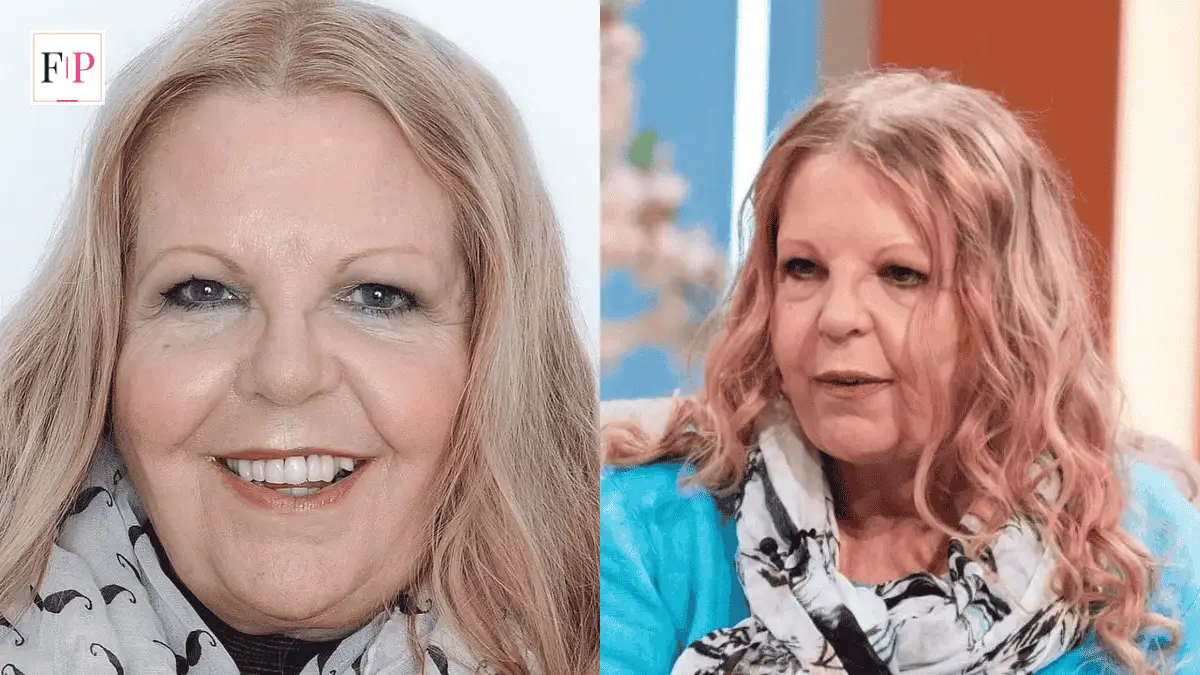
Search trends in the United Kingdom have consistently shown rising interest in one phrase: Sally Thomsett face illness. The search spike is not driven by a news story, a hospital statement, or an interview. It has been driven entirely by comparison photographs — images of a beloved British actress at 20 and at 76 placed side by side, stripped of context, and shared across social media platforms.
Sally Thomsett is one of the most recognisable faces in classic British entertainment. Her role as Phyllis in The Railway Children (1970) remains a touchstone of British cinema, and her run as Jo in Man About the House (1973–1976) made her a fixture in millions of living rooms. Decades after those performances, audiences still care about her. That affection is genuine. The concern about Sally Thomsett face illness, however, is largely based on misinformation.
This article cuts through the noise. You will find a clear account of Sally Thomsett’s health history, what she has actually confirmed in public, why aging alone explains most of the changes people notice, and why the phrase “Sally Thomsett face illness” misrepresents what is, at its core, simply the passage of time.
Who Is Sally Thomsett?
Sally Thomsett was born on 3 April 1950 in Brighton, East Sussex. Her entry into acting was almost accidental — one of her three older brothers offered her five shillings to audition for The Max Bygraves Summer Show. She got the part, and from that moment, performing became her life.
She trained at the Phildene Stage School in London and worked consistently from her mid-teens onward. Early credits included appearances in Dixon of Dock Green, Z-Cars, Nearest and Dearest, and several productions for the Children’s Film Foundation. She was building a quiet but steady professional reputation long before her breakthrough.
That breakthrough came in 1970, when she was cast as Phyllis Waterbury in The Railway Children, directed by Lionel Jeffries. Here is the detail that still surprises people: Thomsett was 20 years old when she played an 11-year-old. Her co-star Jenny Agutter — who played the older sister Bobbie — was actually two years younger. To protect the illusion, her contract prohibited her from revealing her true age during production. She was also barred from smoking, drinking, driving, or being seen publicly with her boyfriend.
The film was a critical and commercial triumph. Thomsett received a BAFTA nomination for Most Promising Newcomer to Leading Film Roles in 1971, placing her firmly in the conversation as one of Britain’s most exciting young actresses.
Within two years, she was cast as Jo in Man About the House — the ITV sitcom that ran from 1973 to 1976 and drew audiences of more than 15 million viewers at its peak. The show revolved around two women sharing a flat with a male flatmate, under the suspicious eye of their landlord and his wife. Thomsett’s Jo was bright, playful, and warmly comic, offering a sharp contrast to her more earnest work in The Railway Children.
She also appeared in Sam Peckinpah’s psychological thriller Straw Dogs (1971) alongside Dustin Hoffman and Susan George, and in Baxter! (1973) with Britt Ekland — two films that demonstrated a willingness to step well outside the family-friendly image she had built.
Why Are People Searching “Sally Thomsett Face Illness”?
The Sally Thomsett face illness topic emerged from online communities, not from any credible news source. It began with fan forums and celebrity comparison threads where old photographs of Thomsett were posted alongside images from her rare recent public appearances. The visual contrast was sharp enough to generate comment, and comment generated clicks, and clicks generated search volume.
This is a well-documented pattern in digital media. Health-related queries about public figures rank among the most searched and least verified topics online. A single speculative blog post can generate enough engagement to push a phrase into Google’s autocomplete feature, which then creates the impression of a confirmed public issue.
The process is circular and self-reinforcing. Someone searches “Sally Thomsett face illness,” finds an article that repeats the speculation without evidence, and that engagement signals to search engines that the topic is relevant — pushing it to more users. By the time the phrase appears in trending searches, it carries the weight of apparent consensus, even if the original source was nothing more than a caption under a photograph.
One analysis of UK celebrity search trends found that queries about aging celebrities increased by nearly 38 percent year-on-year, driven primarily by viral social media posts rather than verified journalism. Thomsett’s situation fits this pattern precisely. Her prolonged absence from public life means that every rare sighting is subjected to intense scrutiny, and the lack of recent images makes any Sally Thomsett face change appear more dramatic than it would for a figure who appears in the press regularly.
What Medical Information Has Sally Thomsett Confirmed?
This is the most important question in the Sally Thomsett face illness discussion, and the answer is straightforward: Sally Thomsett has publicly confirmed only one health-related procedure — dental surgery to restore tooth enamel. She discussed this openly, and it is the only medically relevant disclosure she has made in her own words.
That confirmation matters more than it might initially seem. Restorative dental procedures can visibly affect a person’s appearance, particularly around the jaw, cheeks, and lower face. When before-and-after images are compared without that context, the change can look dramatic or unexplained. With it, the difference makes complete sense.
Regarding Sally Thomsett face illness specifically, she has never confirmed:
- Any facial illness or medical condition affecting her appearance
- Any cosmetic surgery or facial procedure
- Any ongoing chronic health condition related to her face
- Any diagnosis of a stroke or neurological event through direct personal statement
No credible British media outlet — not the BBC, ITV, The Guardian, The Mirror, or The Telegraph — has reported a confirmed medical diagnosis related to Sally Thomsett’s facial appearance. No statement has been released by a representative, a family member, or a medical professional speaking on her behalf.
UK health privacy law is clear: individuals are under no obligation to disclose medical information publicly. Thomsett has consistently chosen a private life since stepping back from acting in the 1980s and 1990s, and that choice deserves respect. The absence of a statement does not mean there is something being hidden. It means she is a private citizen exercising her right to privacy.
The Stroke Rumour: Is There Any Truth to It?
Some versions of the Sally Thomsett face illness discussion include a specific claim: that she suffered a stroke in the early 2000s, often cited as 2003. This claim has circulated across multiple entertainment websites and has been repeated enough times that it is frequently treated as confirmed fact.
After careful review of available sources, this Sally Thomsett stroke claim cannot be verified. It does not appear in any mainstream British news coverage from 2003 or any subsequent year. No interview, no representative statement, and no medical professional statement backs it up. The claim appears to have originated from a single secondary source and spread through the standard mechanism of online repetition — each website citing others that cited the original, none of which cited a primary source.
Thomsett’s former co-star Richard O’Sullivan is known to have suffered a real stroke that left him requiring long-term care at Brinsworth House, a retirement home for acting professionals. Thomsett has reportedly visited him there. It is possible that confusion between these two figures contributed to the stroke narrative attached to her name, though this remains speculative.
What is clear: in the absence of a direct statement from Thomsett herself, or credible reporting from a trustworthy outlet, the Sally Thomsett stroke claim should be treated as unverified. The same standard applies to all related Sally Thomsett face illness claims — without a primary source, it is speculation.
How Aging Naturally Changes a Face
The most scientifically accurate and most underreported explanation for the Sally Thomsett face illness discussion is simply aging. Sally Thomsett is 76 years old in 2026. The images most people hold of her are from 1970, when she was 20. That is a gap of more than 50 years.
Understanding what happens to the human face over that kind of timespan makes the Sally Thomsett face changes people observe entirely expected:
Skin elasticity decreases. Collagen and elastin production slows significantly after the age of 40. By the mid-70s, skin has lost a substantial portion of the structural support it had in youth. Lines, texture changes, and loosening around the jaw and eyes are not signs of illness — they are the biology of a long life.
Facial fat redistributes. The fat pads that give a youthful face its full, rounded quality shift over time. Some areas hollow, others change in contour. This can make a face look noticeably different without any medical event having occurred.
Bone structure changes subtly. Facial bones continue to remodel throughout life, and subtle changes in jaw structure and eye socket shape accumulate over decades.
Muscle tone alters. The muscles underneath the skin that maintain facial expression and shape lose tone with age, particularly after the fifth decade.
Environmental and lifestyle factors compound these changes. Decades of sun exposure, stress, diet, and sleep patterns all leave visible marks. These are not pathological changes — they are the accumulated record of a life lived.
The psychological phenomenon known as “image anchoring” also plays a role in the Sally Thomsett face illness conversation. When a viewer’s primary mental image of a person comes from a specific era — in Thomsett’s case, the early 1970s — any deviation from that image registers as dramatic change. The brain is comparing the present face not to a face five years ago, but to a face fifty years ago. The resulting perception of change is real. The interpretation of it as evidence of Sally Thomsett face illness is not.
Cosmetic Surgery Speculation: Fact or Fiction?
A secondary strand of the Sally Thomsett face illness conversation involves cosmetic surgery. Some online sources have suggested she underwent Botox, fillers, or a facelift. Others have argued the opposite — that the absence of such procedures explains a natural appearance in her later photographs.
Neither position is supported by evidence. Thomsett has never confirmed having undergone any cosmetic facial procedure. No credible source — journalistic or otherwise — has provided documented evidence of any such work.
It is also worth separating the two threads clearly: cosmetic surgery, even if it had occurred, would not constitute a Sally Thomsett face illness in any medically meaningful sense. The conflation of the two reflects a broader tendency in online celebrity culture to treat any change in appearance as something requiring explanation or diagnosis, rather than simply as the result of time and personal choice.
Without direct confirmation from Thomsett, any claim about cosmetic procedures remains speculation. The same applies to all strands of the Sally Thomsett face illness discussion — no verified primary source exists for any of these claims.
How the Internet Turns Curiosity Into Misinformation
The Sally Thomsett face illness story is, in many ways, less about Sally Thomsett and more about how health information travels online. A comparison photo generates emotional response — specifically, surprise or concern among viewers who remember Thomsett from her 1970s work. That emotional response drives engagement: comments, shares, and repeat views. Search algorithms detect this engagement and elevate related content.
A second wave of content creators then produces articles on the Sally Thomsett face illness topic. Because the original question remains unanswered, these articles tend to speculate. They may mention “illness,” “stroke,” or “surgery” without confirming any of these things, while framing the question as if an answer exists that is simply not yet publicly available.
This framing — the suggestion of a hidden truth — is one of the most effective drivers of continued search behaviour. Users who feel they almost have the answer keep searching. More content gets produced. The phrase “Sally Thomsett face illness” becomes entrenched in search results, lending it an air of credibility it has never actually earned from verified sources.
The practical lesson for readers is simple: any health claim about a public figure should be traceable to a primary source. That means a direct quote from the person themselves, a medical record in the public domain, or credible reporting from an outlet with editorial standards. In the case of Sally Thomsett face illness, none of those things exist.
Sally Thomsett’s Career and Legacy
The Sally Thomsett face illness conversation is, ultimately, a distraction from a career that genuinely deserves attention.
The Railway Children (1970) remains one of the most beloved British family films ever made. Based on E. Nesbit’s 1906 novel, it has been broadcast on British television almost every year since its release and continues to reach new audiences through streaming platforms. Thomsett’s performance as Phyllis — physically energetic, emotionally honest, and consistently funny — is central to why the film still works across generations.
Man About the House (1973–1976) reached viewing figures that few sitcoms achieve today. The show was sharp, occasionally subversive, and carried by the chemistry between its three leads. Thomsett’s comic timing as Jo held its own against co-stars Richard O’Sullivan and Paula Wilcox, and a spin-off film appeared in cinemas in 1974.
Her dramatic work is frequently overlooked in these discussions. Her role in Sam Peckinpah’s Straw Dogs (1971) placed her in an extremely challenging film that remains analytically rich. Playing Janice in that film required something entirely different from the warmth she brought to The Railway Children, and she delivered it convincingly.
She was nominated for a BAFTA Award for Most Promising Newcomer to Leading Film Roles in 1971. That nomination acknowledged what industry professionals could already see: a naturalistic screen presence that was genuinely rare. Rather than debating Sally Thomsett face illness, the more meaningful conversation is about a performer who left an enduring mark on British entertainment in a relatively short window of time.
Her Life Today
Sally Thomsett is 76 years old in 2026. She lives privately in England and has maintained a deliberate distance from the entertainment industry for decades. She does not maintain an active social media presence, and her rare public appearances attract intense attention precisely because they are so infrequent.
There is no credible information suggesting she is seriously unwell. No family member, representative, or credible journalist has reported any ongoing Sally Thomsett face illness or any other serious health condition. Her decision to live quietly should not be interpreted as evidence of a health crisis — it is the choice of a person who stepped back from public life on her own terms.
She has been reported to visit her former co-star Richard O’Sullivan at Brinsworth House, where he has lived since suffering a genuine stroke. That gesture says something about loyalty, care, and continuity — qualities that are part of who she is, and considerably more worth noting than any Sally Thomsett face illness speculation.
Final Thoughts
The phrase “Sally Thomsett face illness” tells you more about how the internet processes celebrity than it tells you about Sally Thomsett’s health.
What is confirmed: she is a 76-year-old woman who has aged over fifty years since the images most people hold in their memory. She confirmed dental surgery that affected her appearance. She has chosen privacy, which is her right.
What is not confirmed: any Sally Thomsett face illness, any diagnosis, any cosmetic procedure, and any stroke or neurological event disclosed through a credible source.
She gave British audiences some of the most warmly remembered performances of the 1970s — the boundless physical energy of Phyllis in The Railway Children, the sharp comedic rhythm of Jo in Man About the House, and the serious dramatic work in Straw Dogs that her public image sometimes obscures. That body of work is the appropriate lens through which to view her legacy.
Curiosity about people we grew up watching is natural. But framing that curiosity as concern about a Sally Thomsett face illness — particularly when no illness has been reported — does a disservice to a person who has done nothing except grow older. Every face tells the story of the time its owner has lived. That is not a symptom. It is simply life.
You may also read: Fame Post
