


Remembrance Sunday 2026 falls today, Sunday 8 November 2026, and at 11am the whole country will stop for two minutes to remember the men and women who died serving in the British and Commonwealth armed forces.
The centrepiece of Remembrance Sunday 2026 is the National Service of Remembrance at the Cenotaph in Whitehall, London, where the King leads the nation in silence and wreaths are laid at the foot of the memorial.
Millions more will mark the day at local war memorials, in churches and at home, wearing a red poppy and joining the silence wherever they happen to be.
This guide explains what Remembrance Sunday is, the exact timings for today, how the two-minute silence works, and how you can watch or attend.
Everything below follows the official running order published by the government, so the times are the ones that apply today.
What time is the Remembrance Sunday 2026 service? The National Service of Remembrance at the Cenotaph in Whitehall starts at 11am today, Sunday 8 November 2026, with the two-minute silence at 11am, and the service concludes at 11:25am, followed by the veterans’ march past. Whitehall opens to the public at 8am, and the service is broadcast live on BBC One, ITV and Sky.
What Is Remembrance Sunday?
Remembrance Sunday is the day each year when the United Kingdom remembers all those who have died serving in the British and Commonwealth armed forces, and it is held on the Sunday nearest to 11 November. In 2026 that Sunday is today, 8 November.
The day grew out of the Armistice that ended the First World War at 11am on 11 November 1918. That is why the silence is still held at 11am, and why the eleventh hour of the eleventh day of the eleventh month carries such weight.
Remembrance Sunday 2026 is not only about the two world wars. The day honours those who died in every conflict since, and those who suffered as a result of their service.
It is also a day for the living. Serving personnel, veterans and their families are at the heart of the commemorations, and the march past at the Cenotaph is their moment in the day.
Across the country, the pattern is the same. A service at a war memorial or in a church, the sounding of the Last Post, two minutes of silence, and then wreaths laid in memory of the fallen.
Many people also observe Remembrance Sunday 2026 quietly at home. The silence needs no ticket, no travel and no ceremony of its own, and that is part of its power.
Remembrance Sunday 2026 is especially poignant because it falls in the year after the country marked the 80th anniversary of the end of the Second World War. The generations who fought in that war are now very few, and the act of remembering is increasingly carried by their families.
The phrase most often heard today is “Lest we forget.” It is a promise that the sacrifice of the fallen will not be forgotten, and it is repeated at services across the country.
Remembrance Sunday 2026: Today’s Timings at the Cenotaph
The National Service of Remembrance is held today at the Cenotaph on Whitehall in London, and the official running order is set out below. The times are UK time, with Pakistan time (PKT) alongside for readers following from abroad.
The Remembrance Sunday 2026 service is coordinated by the Department for Culture, Media and Sport, working with the armed forces and veterans’ organisations.
| Time (UK) | Time (PKT) | What happens |
|---|---|---|
| 8:00am | 1:00pm | Whitehall opens to the public; spectators can take their places on the pavements |
| 10:30am | 3:30pm | Detachments form up at the Cenotaph |
| 10:50am | 3:50pm | Participants process out towards the Cenotaph |
| 11:00am | 4:00pm | Two-minute silence begins; the National Service of Remembrance starts |
| 11:25am | 4:25pm | Service concludes; the veterans’ march past begins |
The key time to remember is 11am. That is when the silence begins, the service starts, and the whole country pauses together.
The full official guidance, including the running order and advice for spectators, is published on GOV.UK.
If you are watching from home, the television coverage begins well before the service itself. BBC One’s coverage starts at 10:15am, so you can follow the build-up, the arrival of the detachments and the procession before the silence.
The service itself is short and formal, lasting about 25 minutes. It is followed by the wreath laying and then the march past, which takes considerably longer as thousands of veterans file past the Cenotaph.
The Two-Minute Silence: What Happens at 11am
The two-minute silence is the heart of Remembrance Sunday 2026. At 11am today, everything stops: the service, the crowds on Whitehall, and millions of people across the country.
The silence is marked by guns fired by the King’s Troop Royal Horse Artillery on Horse Guards Parade. The first gun marks the start of the silence, and a second marks its end.
The Last Post is sounded before the silence, and the Reveille follows it. The Last Post is the bugle call that once marked the end of the military day, and it has become the sound most closely associated with remembrance.
His Majesty The King leads the nation in the two-minute silence at the Cenotaph today. Members of the Royal Family and senior politicians then lay wreaths at the foot of the memorial, as confirmed in the government’s announcement for today.
You do not need to be at the Cenotaph to take part in Remembrance Sunday 2026. The silence is observed at 11am in workplaces, schools, shopping centres, railway stations and homes across the UK.
If you are out and about at 11am, simply stop, stand still and bow your head for two minutes. There is no set prayer or form of words required, and quiet reflection is entirely in keeping with the occasion.
Children are often unsure what to do during the silence on Remembrance Sunday 2026, and the simplest explanation is the best one. Tell them that for two minutes we are quiet to remember the people who died so that we could live in peace.
The silence also takes place on Armistice Day itself, Wednesday 11 November 2026, at 11am. That is a separate, shorter observance, while today’s service is the main national ceremony.
The Cenotaph and the National Service of Remembrance
The Cenotaph on Whitehall is the United Kingdom’s national war memorial, and it is the focal point of Remembrance Sunday every year. Its name comes from the Greek words for “empty tomb”, because it is a memorial to the fallen rather than a grave.
The memorial was designed by the architect Sir Edwin Lutyens and unveiled in its permanent stone form on 11 November 1920. It bears the simple inscription “The Glorious Dead”.
The first, temporary Cenotaph was built of wood and plaster in 1919 for the peace celebrations after the First World War. The public response was so overwhelming that a permanent version was commissioned, and it has stood on Whitehall ever since.
Today’s Remembrance Sunday 2026 service follows a pattern that has changed little over the decades. Hymns, prayers and readings are followed by the silence, the wreath laying and the march past.
The wreath laying is the most solemn moment of the service. Wreaths of red poppies are laid at the foot of the Cenotaph by the King, members of the Royal Family, senior politicians and representatives of the Commonwealth, the armed forces and faith communities.
After the official wreaths, the march past begins. Thousands of veterans, many of them elderly, march past the Cenotaph in their regimental and association groups, and the crowds applaud them as they pass.
The march past is organised by the Royal British Legion, and it is the part of the day that most visibly honours the living. Many of those marching wear the medals of relatives who did not come home.
The Festival of Remembrance at the Royal Albert Hall took place last night, Saturday 7 November, as the traditional opening to the Remembrance Sunday 2026 weekend. It is a concert of music and remembrance, and it was broadcast on BBC One.
Poppies and the Royal British Legion
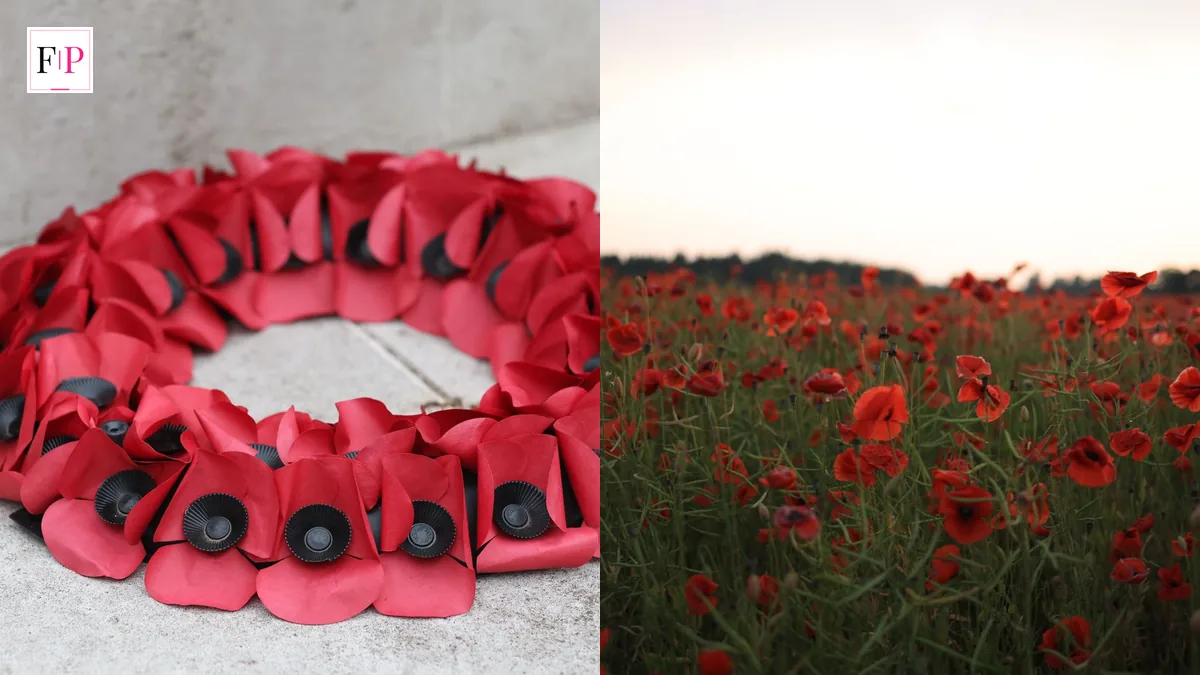
The red poppy is the symbol of remembrance in the UK on Remembrance Sunday 2026, and you will see it everywhere today: on lapels, on wreaths, and laid at war memorials across the country.
The poppy became the symbol of remembrance because of the poppies that grew on the battlefields of Flanders during the First World War. The connection was made famous by the poem “In Flanders Fields”, written by the Canadian officer John McCrae in 1915.
The Royal British Legion, founded in 1921, is the national custodian of remembrance in the UK. It organises the annual Poppy Appeal and the Festival of Remembrance, and it supports serving and former members of the Armed Forces community and their families.
The Poppy Appeal raises money to help the Armed Forces community with financial hardship, housing, health and wellbeing, rehabilitation and companionship. Poppies are sold by volunteers in the weeks leading up to Remembrance Sunday, and donations can also be made online.
A paper poppy is traditionally worn on the left side, over the heart, although the Legion itself says there is no single correct way to wear one. What matters is the act of remembrance, not the exact position of the pin.
As well as paper poppies, the Legion sells poppy pins, wreaths and crosses. Small wooden crosses bearing a poppy are often placed at war memorials and in Fields of Remembrance, including the Field of Remembrance outside Westminster Abbey.
Some people choose to wear a white poppy alongside or instead of a red one, as a symbol of peace. The white poppy is a separate tradition, and both are seen at remembrance events each year.
Children’s poppies and poppy-themed school activities are a common sight in the week before Remembrance Sunday, as schools teach the next generation why the day matters.
If you have not bought a poppy for Remembrance Sunday 2026 yet, it is not too late. Poppies are still available from Legion collectors and shops today, and a donation of any size supports the Appeal.
How to Watch or Attend Remembrance Sunday 2026 Today
Whether you are in London or watching from home, there are several ways to follow Remembrance Sunday 2026 today. The steps below cover both options.
- To attend in person, arrive early — Whitehall opens to the public at 8am, and there are no tickets or passes needed. Spectators watch from the pavements along Whitehall and Parliament Street, so arrive well before 11am to find a good spot.
- Dress for standing outside — You will be standing on a London street in November, so wear warm layers, a waterproof coat and comfortable shoes, and allow extra time for security checks and road closures around Whitehall.
- Watch on BBC One — Live coverage of the Cenotaph service starts on BBC One and BBC iPlayer at 10:15am and runs through the service and the march past. Highlights are shown on BBC Two in the evening.
- Watch on ITV or Sky — The service is also broadcast live on ITV and Sky News, including on the Sky News app, website and YouTube, so you can follow it on television, a laptop or a phone.
- Listen on the radio — BBC Radio 4 carries live coverage of the service, and it is also available on BBC Sounds, which is useful if you are travelling at 11am.
- Join the silence wherever you are — If you cannot watch or attend, simply stop at 11am for two minutes. The silence is the same whether you are at the Cenotaph, at a local memorial or at home.
The government’s announcement for today confirms the King leads the nation in silence and that the service is broadcast live on the BBC, ITV and Sky News. Full details are on GOV.UK.
If you are travelling to London for Remembrance Sunday 2026, check the latest travel advice before you set off. Roads around Whitehall are closed for the ceremony, and the nearest Tube stations are Westminster and Embankment.
Photography is welcome from the public areas, but remember that this is a solemn occasion. Keep phones silent during the service and the two-minute silence.
Remembrance Sunday 2026 Around the UK
London is not the only place marking Remembrance Sunday 2026 today. Services and parades are taking place at war memorials in towns and cities across the whole of the UK.
Most local Remembrance Sunday 2026 services follow the same shape as the national one. A parade to the war memorial, a short service, the Last Post, the two-minute silence at 11am, and wreaths laid by the mayor, local dignitaries and veterans’ groups.
Local Royal British Legion branches organise many of these services, often together with the local council. They are open to everyone, and no ticket is needed to attend.
Churches across the country are also holding remembrance services this morning, many of them timed so that the congregation can join the 11am silence together.
If you cannot get to a service, the 11am silence is the part that matters most. It is observed at the same moment everywhere in the UK, so a person standing alone at home is remembering at exactly the same time as the crowds on Whitehall.
Schools, sports clubs and workplaces have also been marking the week in their own ways, from assemblies to a minute’s silence before weekend matches. Many football matches this weekend are holding a period of silence before kick-off, with players wearing poppy shirts.
After today, the focus moves to Armistice Day itself. On Wednesday 11 November 2026, a short service and a two-minute silence will be held at 11am at war memorials and workplaces across the country, marking the exact moment the guns fell silent in 1918.
The poppies laid at the Cenotaph today will remain in place for days afterwards, and many people visit Whitehall in the days after Remembrance Sunday to see the wreaths and pay their own respects.
Final Thoughts: How to Mark the Day Today
Remembrance Sunday 2026 is a day to pause, and the simplest ways to mark it are the most meaningful ones. Wear a poppy, join the silence at 11am, and take a moment to think about the people the day honours.
If you can, watch the service from the Cenotaph, even for a few minutes. The sight of the veterans marching past, and the sound of the Last Post over a silent Whitehall, is something that stays with you.
Talking to children and grandchildren about remembrance is part of the day too. The stories of those who served are best kept alive by the families who tell them.
And if you are able to give, a donation to the Poppy Appeal helps the Royal British Legion support the Armed Forces community all year round, not just in November.
Lest we forget.
What time is the Remembrance Sunday 2026 service at the Cenotaph?
The National Service of Remembrance at the Cenotaph in Whitehall starts at 11am today, Sunday 8 November 2026, and concludes at 11:25am. Whitehall opens to the public at 8am, detachments form up at 10:30am, and participants process out at 10:50am. The veterans’ march past begins after the service ends at 11:25am.
What time is the two-minute silence on Remembrance Sunday 2026?
The two-minute silence is at 11am today, Sunday 8 November 2026. It is marked by guns fired by the King’s Troop Royal Horse Artillery on Horse Guards Parade, with the Last Post sounded before the silence and the Reveille afterwards. The King leads the nation in the silence at the Cenotaph.
Can I attend the Cenotaph service in person?
Yes. No tickets or passes are needed to watch the National Service of Remembrance. Whitehall opens to the public at 8am and spectators can watch from the pavements along Whitehall and Parliament Street. Arrive well before 11am to find a place, and dress warmly for standing outside in November.
Where can I watch Remembrance Sunday 2026 on TV?
The service is broadcast live on BBC One and BBC iPlayer from 10:15am, and also live on ITV and Sky News. BBC Radio 4 carries live radio coverage, and highlights are shown on BBC Two in the evening. The service is also available to watch on the Sky News app, website and YouTube.
What is the difference between Remembrance Sunday and Armistice Day?
Remembrance Sunday is held on the Sunday nearest to 11 November — in 2026 that is Sunday 8 November — and it is the main national ceremony, centred on the service at the Cenotaph. Armistice Day is Wednesday 11 November 2026, the anniversary of the Armistice that ended the First World War at 11am on 11 November 1918, and it is marked by a two-minute silence at 11am.
Why do we wear poppies on Remembrance Sunday?
The red poppy became the symbol of remembrance because poppies grew on the battlefields of Flanders during the First World War, a connection made famous by John McCrae’s 1915 poem “In Flanders Fields”. Poppies are sold by the Royal British Legion’s Poppy Appeal, which raises money to support the Armed Forces community and their families.
