



On 2 November 2026, a 57-year-old man walked into Queen Victoria Square in Hull to cheering crowds, 28 years and one day after he had set out from the southern tip of South America. Karl Bushby had just completed what is described as the first unbroken walk around the world: roughly 31,000 miles on foot, across about 30 countries, four continents, a frozen sea and two long swims, all under two rules he had set himself as a young man. He had left Punta Arenas in Chile on 1 November 1998 expecting the journey to take about 12 years. It took more than twice as long, and it made him one of the most remarkable adventurers of modern times.
For readers in the United Kingdom, the story of Karl Bushby is a Hull story as much as it is a world story. He was born in the city, served as a paratrooper, and set his finish line at his mother’s home there. For 28 years he did not go home, because his own rules forbade it until the walk was finished. This article sets out who Karl Bushby is, how the Goliath Expedition unfolded, why it took so long, and how it finally ended in November 2026.
Who is Karl Bushby?
Karl Bushby was born on 30 March 1969 in Hull, in the north of England. He served for 12 years in the 3rd Battalion of the Parachute Regiment before leaving the Army at the end of 1997. His life and expedition are documented in detail on his Wikipedia page (https://en.wikipedia.org/wiki/Karl_Bushby). By that point, the idea that would define his life was already taking shape. As Karl Bushby has told it, the plan began with a birthday card from his father in the mid-1990s and grew into a goal: to walk from the southern tip of South America all the way back to Hull, in one unbroken line of footsteps, without using motorised transport to move forward.
He called the project the Goliath Expedition. The planned route was about 36,000 miles, and he expected it to take around 12 years. He set out from Punta Arenas, near Chile’s southern tip, on 1 November 1998, at the age of 29, with about $500 in his pocket and a modified golf trolley loaded with supplies and gear, which he nicknamed “The Beast”. He also set himself two rules that would govern everything that followed. First, no transport of any kind could be used to advance the journey. Second, he could not go home until he had walked there. When visas or borders forced him to leave a country, he had to return to the exact spot where he had stopped before taking another step forward. Those two rules are the reason the expedition lasted 28 years instead of 12, and they are the reason it is regarded as unbroken.
South America and the Darién Gap
The first leg of Karl Bushby’s walk took him north through South America, through Chile, Argentina, Peru, Ecuador and Colombia. It was a long, grinding introduction to the expedition: months of walking through Patagonia and the Andes, then northwards through Central America. The most dangerous early obstacle was the Darién Gap, the roadless stretch of jungle between Colombia and Panama, known for its terrain, its remoteness and the armed groups operating there.
Bushby got through the Darién Gap in early 2001, but the crossing landed him in trouble with the authorities. He was jailed for 18 days in Panama after crossing a restricted border zone without a visa. It was the first of several detentions that would punctuate the expedition, and it set a pattern: the physical walking was only half the challenge, and paperwork, borders and officials were often the harder half. From Panama he continued through Central America and Mexico, and in 2002 he entered the United States, beginning the long walk north towards Alaska.
North America and the Bering Strait
By 2005, Bushby had walked the length of the Americas and reached Alaska, having covered more than 17,000 miles. Ahead of him lay the obstacle that would define the middle of the expedition: the Bering Strait, the stretch of sea between Alaska and Siberia. The strait itself is about 58 miles wide, but in winter it freezes, and crossing it on foot means walking across shifting sea ice, with open water gaps and the risk of meeting polar bears. Karl Bushby carried a rifle on the crossing in case of bears.
His first attempt, in the winter of 2004 to 2005, ran out of time. Spring arrived, the ice began to break up, and his United States visa expired before he could complete the crossing, leaving him as far as Unalakleet in Alaska. He tried again the following winter, this time with French adventurer Dimitri Kieffer. Between 17 and 31 March 2006, the two men crossed the frozen strait on foot, taking a winding 14-day route of about 150 miles across the ice to cover the 58-mile gap between Alaska and Siberia.
Reaching Russia did not mean safety. Bushby and Kieffer were detained by Russian border guards near the Chukotkan village of Uelen, because they had not entered Russia through an official port of entry. They faced a ban that threatened to end the expedition altogether. Karl Bushby appealed, and the appeal was accepted, allowing the walk to continue. He resumed walking in March 2007 from Uelen, on a route lengthened to avoid the summer swamps of Siberia. The Bering Strait crossing remains one of the most celebrated feats of the expedition, and also the start of its longest delay.
The Russian years: visas, detention and a ban
If the Bering Strait was the expedition’s great physical test, Russia was its great bureaucratic one. Bushby spent about a decade crossing Russia, and for much of that time his progress was dictated by visa rules that limited his stays to 90 days within any 180-day period. He would secure a visa, walk as far as he could, leave when it expired, and then try to get back in. In 2007 he walked more than 620 miles from Uelen to Dvoynoye, but when his visa expired he was forced back to Alaska.
The 2008 financial crisis then cost Karl Bushby his sponsors, and he spent the years from 2008 to 2010 in Mexico for financial reasons, unable to re-enter Russia. A new visa was issued in 2010, and he continued the journey the following year, reaching Srednekolymsk in April 2011. But the door closed again: Russia refused him a visa in 2012, and in March 2013 it banned him for five years.
His answer to the ban was itself an epic walk. He walked about 3,600 miles across the United States, from Los Angeles to the Russian embassy in Washington, DC, to press his case. The ban was overturned on 23 October 2014, and he was able to return to Russia and continue eastwards. By 2017 he had reached Mongolia, and from there he moved through Central Asia, including Uzbekistan, where he crossed the Kyzylkum Desert. He was stopped at the border with Iran in 2019, and the Covid-19 pandemic added further delays in 2020. The Russian years explain why a walk planned for 12 years stretched to 28: of the years since 1998, only a fraction were spent actively walking, and the rest were consumed by waiting, bureaucracy and detours.
The Caspian swim and the road to Europe
By 2024, the remaining overland route presented Bushby with a problem that walking alone could not solve. The routes through both Russia and Iran were closed to him, and the only way to keep the line unbroken without using a boat or a vehicle was to swim. In September and October 2024, Karl Bushby swam about 179 miles (288 kilometres) across the Caspian Sea, from Kazakhstan to Azerbaijan, spending 31 days at sea. He swam with American long-distance walker Angela Maxwell, along with two teenage Azerbaijani national swimming champions and a maritime support team.
The swim was not a shortcut. Under Karl Bushby’s own rules, a boat would have broken the expedition, but swimming under his own power did not. The same logic would govern the final obstacle of the journey two years later. From Azerbaijan, his route took him through Georgia and Turkey, including Istanbul, and then westwards through Europe: Bulgaria, Romania, Hungary, Austria, Germany, Belgium and France. He crossed 787 kilometres through Bulgaria to reach the Romanian border in early October 2025, and by that point about 2,213 kilometres remained to Hull, with arrival expected in the following year. The European leg was, by the standards of the expedition, comparatively straightforward walking, but it carried its own weight: after more than a quarter of a century, home was finally measurable in hundreds of kilometres rather than continents.
The English Channel swim
The last obstacle of the Goliath Expedition turned out to be one of the shortest distances on the map: the English Channel. Karl Bushby had hoped to walk through the Channel Tunnel’s service corridor, but Eurotunnel refused permission over safety and maintenance concerns. Swimming became the only remaining option under his rules, and the French authorities granted permission for the attempt in early September 2026.
Bushby spent about 20 hours in the water over three days before coming ashore at Shakespeare Beach, just south of Dover, on 5 October 2026. His father, his brothers and a camera crew led by filmmaker Werner Herzog were waiting on the beach. It was his first time on British soil in 28 years, and he has described himself as a poor swimmer, which makes the crossing all the more striking. From Dover, about 400 kilometres (roughly 250 miles) remained to Hull, and he walked north through England, photographed in Peterborough on 22 October 2026 during the final leg. He crossed the Humber Bridge on 1 November, exactly 28 years after setting out from Punta Arenas.
Home to Hull: the finish
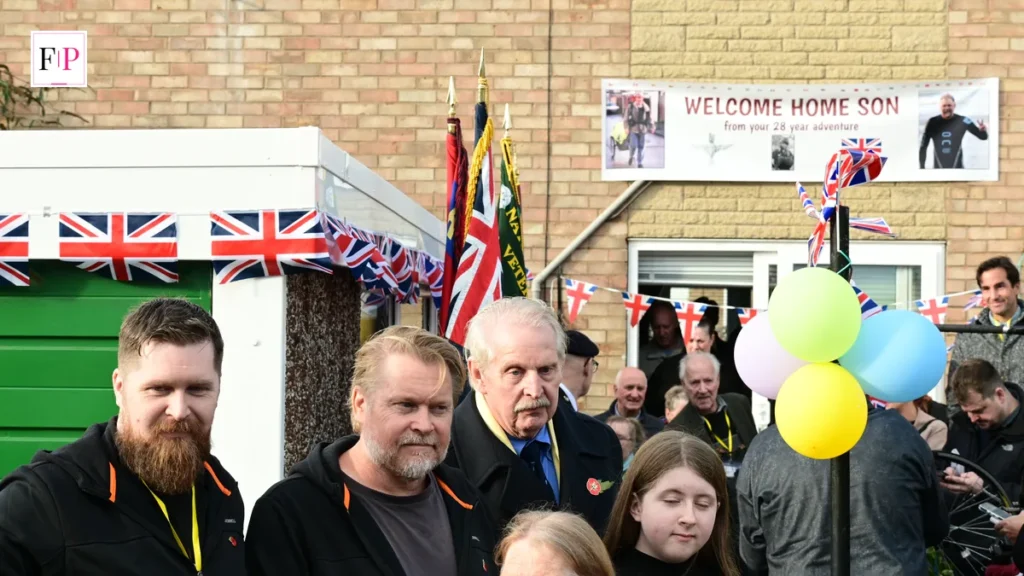
On Monday 2 November 2026, Karl Bushby walked into Queen Victoria Square in Hull to cheers from hundreds of well-wishers, 28 years and one day after he had left South America. He then finished at his mother’s home in Sutton Park, Hull, completing a journey of about 31,000 miles (50,000 kilometres). Reports put the total at roughly 30 countries, four continents, seven mountain ranges and six deserts, along with the Darién Gap, the Bering Strait and two long swims, as set out in Backpacker’s by-the-numbers account of the walk (https://www.backpacker.com/news-and-events/news/31000-miles-28-years-karl-bushbys-goliath-expedition-by-the-numbers/?scope=anon). He was 57 years old, and he had been 29 when he started.
The finish was also a family moment. Karl Bushby’s mother, whom he had not seen since 2015 according to reports, was at the end of the walk, and his father and brothers had met him at Dover a month earlier. He had left behind a young son when he set out in 1998, a fact that has drawn comment in coverage of the expedition, and the homecoming closed a separation measured in decades rather than years. For Hull, the finish turned a local man into a world story: the boy from the city had walked home the longest possible way.
What happens next for Bushby is already taking shape, according to reports. A sequel to his memoir is planned, a documentary by Werner Herzog is in the works, and he has speaking engagements lined up in the months after the finish. His book Giant Steps, first published in 2005 with a later edition covering events up to the Bering Strait crossing in March 2006, tells the story of the first part of the walk. National Geographic also aired a documentary, The Walk Around the World, on 15 May 2015, with Karl Bushby as both subject and cinematographer, following his protest walk to the Russian embassy. The full story of the second half of the expedition, from Siberia to Hull, is the book that readers are now waiting for.
Why the walk of Karl Bushby matters
It is worth asking why the walk of Karl Bushby has captured so much attention in Britain and beyond, when other adventurers have crossed continents before. Part of the answer is the sheer scale: 28 years is longer than many marriages, careers and childhoods, and it means the expedition outlasted the world it began in. Karl Bushby set out before smartphones, streaming services and social media existed, and he finished in a world transformed by all three. Part of the answer is the rules. Anyone can travel around the world; very few people would refuse every vehicle, every boat and every flight for nearly three decades, and return to the exact spot where they stopped after every enforced break.
There is also a British dimension that should not be overlooked. The United Kingdom has a long tradition of endurance adventurers, but Karl Bushby’s expedition is unusual in that it was not a race, a record attempt measured in days, or a sponsored stunt with a film crew in tow for most of its length. For long stretches it was a solitary, self-funded walk, interrupted by years of waiting in Mexico, by visa offices and by the loss of sponsors in a financial crisis. That is a very different kind of adventure from the polished expeditions most people see on television, and it is arguably a more honest one.
Finally, there is the simple human fact at the centre of it. Karl Bushby walked home. Every step of the Goliath Expedition pointed towards a front door in Hull, and for 28 years that door stayed closed to him by his own choice. The image of a 57-year-old man walking into Queen Victoria Square, greeted by crowds, and then walking up to his mother’s house, is powerful precisely because it is so ordinary at the end of something so extraordinary. He did not finish with a flourish or a stunt. He finished by arriving, on foot, where he had always said he would.
Sponsorship, setbacks and the cost of walking
One of the least glamorous truths about the Goliath Expedition is that it was, for most of its length, a financial struggle as much as a physical one. Bushby set out with very little money and no guarantee of sponsorship, and the expedition remained self-funded through personal resources and sponsorships accumulated over 27 years, according to expedition coverage. When sponsors withdrew after the 2008 financial crisis, the walk simply stopped for two years while he waited in Mexico. There was no team of backers keeping the project alive in the background; there was a man waiting for the money and the paperwork to allow him to walk again.
The same pattern applied to visas. When a visa expired, Bushby flew away to wait — to Bogotá in 2002 to renew a visa, and to Mexico more than once — and then returned to the exact spot where he had stopped before taking another step. That detail matters, because it explains how the expedition can be both honest and unbroken at the same time. The rule was never that he could not leave the route; it was that no transport could move him forward along it, and that he could not go home until he had walked there. Flying away from the line to wait, and then flying back to the same point, moved him nowhere forward, and it is why the line on the map remained continuous even though the calendar did not.
The daily reality of the walk was also far removed from the image of an adventurer striding through dramatic landscapes every day. Much of it was ordinary road walking, in all weathers, through towns and farmland as well as mountains and deserts, carrying or pushing supplies, finding food and shelter, and dealing with injury, illness and loneliness. The expedition’s own account of the European leg describes rigorous on-foot routines and minimal external support, and that description fits the whole journey. Bushby walked through seven mountain ranges and six deserts, according to expedition summaries, but he also walked thousands of unremarkable miles that never made a headline. The extraordinary total is made up of ordinary days, repeated for 28 years.
Public attention came late. For most of the expedition, Bushby was known mainly to adventure enthusiasts and to readers of his book. It was only in the final years, as the finish line came into view, that national newspapers and broadcasters began following the walk closely, and only in the final weeks that it became a daily news story in Britain. That late attention is part of why the finish felt so sudden to many readers: a man most people had never heard of had, in fact, been walking towards Hull since before many of them were born. The documentary by Werner Herzog, and the planned sequel to Giant Steps, may change that, giving the second half of the walk the audience the first half never had.
Frequently Asked Questions
Who is Karl Bushby?
Karl Bushby is a British adventurer and former paratrooper from Hull, best known for the Goliath Expedition, an unbroken walk from Punta Arenas in Chile back to his home in Hull, England. He set out on 1 November 1998 and completed the walk on 2 November 2026, after about 31,000 miles and 28 years.
What is the Goliath Expedition?
The Goliath Expedition is Karl Bushby’s attempt to walk an unbroken route around the world, from the southern tip of South America to Hull, without using any motorised transport to move forward. He set two rules: no transport to advance the journey, and no going home until he had walked there.
How long did Karl Bushby walk for?
Karl Bushby walked for 28 years and one day, from 1 November 1998 to 2 November 2026. He had originally expected the journey to take about 12 years, but visa troubles, especially in Russia, the loss of sponsors in the 2008 financial crisis, the Covid-19 pandemic and long detours stretched it to nearly three decades.
Did Karl Bushby cross the Bering Strait on foot?
Yes. Between 17 and 31 March 2006, Karl Bushby and French adventurer Dimitri Kieffer crossed the frozen Bering Strait on foot, taking a winding 14-day route of about 150 miles across the sea ice to cover the 58-mile gap between Alaska and Siberia. They were detained by Russian border guards on arrival near Uelen, but an appeal was accepted and the expedition continued.
Why did Karl Bushby swim the Caspian Sea and the English Channel?
Karl Bushby swam both stretches because his rules forbade using a boat or any other transport to move forward, while swimming under his own power did not break them. He swam about 179 miles across the Caspian Sea in 2024 because routes through Russia and Iran were closed, and he swam the English Channel in October 2026 after Eurotunnel refused permission to walk through the service tunnel.
Has Karl Bushby finished the Goliath Expedition?
Yes. Karl Bushby completed the Goliath Expedition on 2 November 2026, when he arrived in Hull’s Queen Victoria Square and then at his mother’s home in Sutton Park, Hull, 28 years and one day after setting out from Punta Arenas, Chile, on 1 November 1998.
