


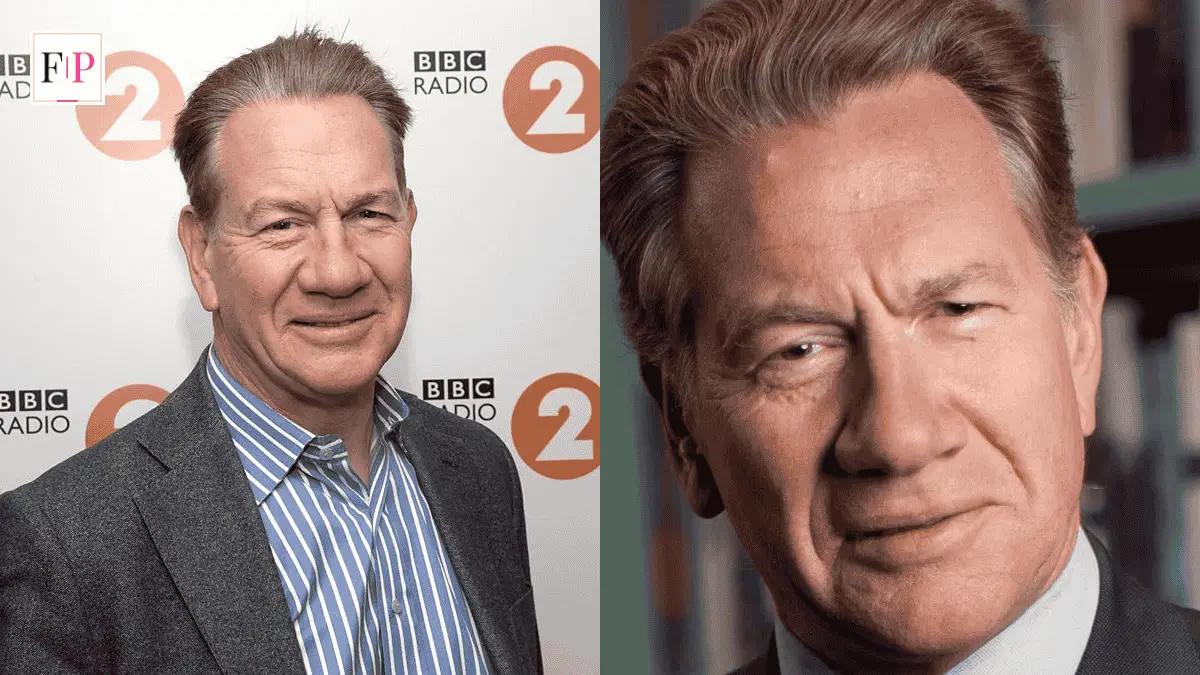
Few British public figures have reinvented themselves as successfully — or as profitably — as Michael Portillo. Once a fiercely ambitious Cabinet minister tipped as a future Prime Minister, he is now known to millions as the colourfully jacketed presenter travelling Britain’s railways with a Victorian guidebook in hand. The shift is genuinely extraordinary. And, as it turns out, it has been remarkably lucrative.
Michael Portillo net worth is currently estimated at between £8 million and £10 million, placing him among the most financially successful former politicians turned broadcasters in modern British public life. That figure has been assembled across four decades through political salaries, a parliamentary pension that continues to generate income today, a hugely popular BBC television franchise, public speaking, journalism, book royalties, and property. It is not the result of one windfall or one decision — it is the product of a long, varied, and carefully navigated professional life.
This article explores how Michael Portillo built his wealth, where his money comes from today, and why his financial story is as fascinating as the television career that currently defines him.
What Is Michael Portillo Net Worth in 2026
Michael Portillo net worth as of 2026 is consistently estimated at between £8 million and £10 million by reputable UK financial and media publications. This figure is not officially confirmed — Portillo has never made a formal public statement about his financial position — but it reflects a comprehensive view of his earnings across more than forty years of professional life. Earlier estimates, often cited in dollar terms and as low as $6.5 million, tended to exclude the full scope of his parliamentary pension, sustained television income, and property holdings. When these are incorporated into a holistic calculation, the £8–10 million range emerges as the most credible assessment consistently reached by multiple independent sources.
It is essential to understand that michael portillo net worth did not arrive from a single role or a sudden commercial windfall. It has been assembled steadily and diversely: political salaries during his Westminster years, a substantial BBC television career that began in earnest in 2010 and has continued into 2026, public speaking fees commanding premium rates, book royalties from publications tied to his television work, journalism commissions, corporate non-executive director positions in earlier post-political years, and the ongoing income from his parliamentary pension. This kind of patient, diversified wealth accumulation — built across many careers rather than one — is precisely what generates the kind of compounding financial stability his estimated net worth reflects.
Compared with other former politicians who have made successful transitions into media, Portillo’s financial standing is notable. His contemporaries who followed similar paths — commentary roles, panel show appearances, occasional documentary work — rarely sustained the level of consistent, prime-time mainstream television output that he has managed across more than fifteen years with the BBC. Sixteen series of Great British Railway Journeys alone, plus numerous international spin-off franchises and other broadcasting engagements, represents an income stream very few retired politicians achieve. Michael Portillo net worth in 2026 is not simply the sum of his cheques — it is a reflection of how completely and durably he built his second career.
Michael Portillo’s Early Life and the Path to Westminster
Michael Denzil Xavier Portillo was born on 26 May 1953 in Bushey, Hertfordshire, to parents whose backgrounds gave him an unusually rich cultural inheritance. His father, Luis Gabriel Portillo, was a Spanish republican exile who fled Madrid when General Franco’s forces seized the city in 1939, settling in England after the end of the Spanish Civil War. His mother, Cora Blyth, was Scottish. This combination — Spanish political exile and Scots-British pragmatism, Catholic tradition meeting Protestant reserve — shaped Portillo’s intellectual curiosity and cross-cultural sensibility in ways that would later define both his political instincts and his television persona. He attended Harrow County Grammar School before winning a place at Peterhouse, Cambridge, where he read history and graduated with a first-class degree.
After Cambridge in 1975, he briefly worked for a shipping company before joining the Conservative Research Department in 1976, where his talent for political analysis and briefing quickly became apparent. He served as a special adviser to Nigel Lawson and Cecil Parkinson, spent a period with Kerr-McGee Oil, and entered Parliament in 1984 as Member of Parliament for Enfield Southgate after winning a by-election. His ascent under Margaret Thatcher was rapid. As Minister of State for Transport between 1987 and 1990, he became personally passionate about railways — and he has cited saving the Settle-Carlisle railway line from closure as the achievement of which he is most proud from his entire political career. It is a detail that takes on considerable biographical resonance when one considers what eventually became his primary source of income.
Under Prime Minister John Major, Portillo continued his rise through some of the most senior positions in the British government. He served as Chief Secretary to the Treasury from 1992 to 1994, Secretary of State for Employment from 1994 to 1995, and Secretary of State for Defence from 1995 to 1997 — one of the most demanding Cabinet roles available. By the mid-1990s, he was widely regarded within the Conservative Party as a potential future leader and Prime Minister. Political salaries at ministerial level, combined with allowances and the accumulation of Privy Council membership, created the early financial bedrock upon which michael portillo net worth would continue building for decades to come.
The Portillo Moment That Reshaped British Political History
On the night of 2 May 1997, one of the most memorable moments in modern British political broadcasting occurred live on television screens across the country. As the results of the general election came in, the announcement that Michael Portillo had lost his Enfield Southgate seat to Labour’s Stephen Twigg — delivered to a studio audience that responded with audible triumph — became instant political folklore. The phrase “Portillo moment” entered the language, used subsequently to describe any similarly unexpected high-profile electoral defeat. For the man at the centre of it, however, that very public humiliation in front of the nation was not the end of anything. It was, with the benefit of hindsight, the beginning of something more lasting.
He returned to Parliament in a 1999 by-election in Kensington and Chelsea, served as Shadow Chancellor of the Exchequer under William Hague between 2000 and 2001, and contested the Conservative leadership following the party’s second consecutive general election defeat. He did not win that leadership contest, and he ultimately stood down from Parliament in 2005 without having regained the frontbench seniority he once held. But the years between his return to Westminster and his eventual departure gave him something arguably more valuable than another Cabinet post: time, reflection, and a growing television presence. Between 2003 and 2019, he was a regular and widely appreciated panellist on the BBC’s political discussion programme This Week, hosted by Andrew Neil, which began reshaping public perceptions of him entirely.
The tone and content of his This Week appearances were markedly different from the combative political Portillo of the 1990s. He was thoughtful, self-deprecating at times, willing to acknowledge the limitations of his own past positions, and genuinely entertaining. Audiences who had known him primarily as a hardline Thatcherite politician discovered someone far more nuanced and likeable. This gradual rehabilitation of his public image, built across sixteen years of consistent broadcasting, was essential groundwork for what came next. When Great British Railway Journeys launched in 2010, Portillo did not arrive as a faded politician attempting to revive a career — he arrived as a trusted, warmly regarded broadcaster entering the next phase of a reinvention already well underway. That positioning proved crucial to the programme’s immediate success and to the subsequent growth of michael portillo net worth.
Great British Railway Journeys and the BBC Income That Built His Fortune
The financial engine most directly responsible for michael portillo net worth in his broadcasting era is, without question, the railway documentary franchise he constructed with the BBC. Great British Railway Journeys uses George Bradshaw’s 1863 tourist handbook as its narrative device, sending Portillo across Britain’s rail network to compare the Victorian world Bradshaw described with the contemporary one he finds at each stop. It is a deceptively simple format: part travel documentary, part local history, part personal reflection. Its warmth and accessibility made it an immediate hit when the first series aired in January 2010, and it has returned for an additional series almost every year since, reaching sixteen series by May 2026 — a record of longevity that few BBC documentary formats can match.
The success of the original series opened the door to an extensive international expansion that has kept Portillo actively employed as a BBC presenter for over fifteen years. Great Continental Railway Journeys covered eight series across Europe. Great American Railroad Journeys launched in 2016, taking his presenting style to a transatlantic audience. Great Indian Railway Journeys followed in 2018. Great Australian Railway Journeys aired in 2019, Great Asian Railway Journeys in 2020, Great Coastal Railway Journeys on BBC2 in early 2024, and by 2026 he was presenting Great Japanese Railway Journeys, Great Korean Railway Journeys, and Great Central Asian Railway Journeys — the last of these following the Silk Road through Uzbekistan. Each new series represents a renewed BBC contract and sustained presenter fees that, accumulated across more than a decade and a half of near-continuous output, form the dominant pillar of his total wealth.
Beyond the railway documentaries, Portillo has maintained a broader broadcasting career that adds meaningfully to his annual income. He has fronted political and historical documentaries across multiple channels, presented Portillo’s Andalucia for Channel 5 in 2023 — exploring the southern Spanish region connected so personally to his father’s history — and hosted a political current affairs show on GB News in 2022. BBC presenter fees for experienced, senior-level documentary hosts with his record of output consistently reach into six-figure territory annually according to industry standards, though precise figures are subject to confidentiality agreements with the corporation. What is beyond dispute is that fifteen-plus years of near-annual BBC commissioning, across multiple successful franchise strands, has contributed an enormous amount to michael portillo net worth as it stands today.
Michael Portillo’s Broader Income Sources and Financial Assets
Television is the dominant but not the only driver of michael portillo net worth, and understanding the full picture requires examining the multiple income streams that run alongside his BBC work. The most significant of these, and one of the most commonly overlooked in celebrity financial analysis, is his parliamentary pension. As a Member of Parliament for more than twenty years and a senior Cabinet minister who served in multiple ministerial roles, Portillo accrued pension entitlements that continue to generate a reliable, inflation-linked annual income. Former Cabinet ministers of his seniority are entitled to substantial pension arrangements, and this ongoing income — completely independent of whether he accepts another television commission — provides a permanent financial base that anchors his overall wealth position.
Public speaking represents another meaningful income stream. Portillo is a highly sought-after keynote speaker and conference host, commanding premium fees at events across the UK and internationally. Testimonials from his speakers’ management have described him as exceptionally effective at engaging both corporate and general audiences, drawing on decades of political experience and broadcasting ease to adapt seamlessly to any room. He has also generated income through writing, including newspaper and magazine journalism and books produced in connection with his television work — notably Greatest British Railway Journeys, published by Headline — which generate royalties that provide passive income ongoing. In the earlier years of his post-political career, he held non-executive director positions at companies including BAE Systems, adding corporate board fees to his broader financial portfolio.
Property is the final and perhaps least discussed dimension of his overall assets. Portillo and his wife Carolyn are reported to own property in London — a city where residential values have risen dramatically over the decades they have been based there — and more recently to have acquired a home in Andalucia, Spain, the region that holds profound personal meaning for Portillo through his father’s republican heritage and exile. London residential property and an Andalucian home together represent assets that have historically appreciated considerably in value, and they add significant weight to the total picture of michael portillo net worth beyond what his active income streams alone would suggest. Property, pension, television, speaking fees, and royalties: together these form a portfolio as diversified and carefully assembled as his career has been.
The Man Behind the Fortune: Personal Life and Lasting Legacy
Behind the colourful jackets and the gently curious television persona is a private man who has navigated his public life with more self-awareness than his critics in the 1990s might have predicted. Michael Portillo married Carolyn Claire Eadie in 1982, and their partnership has endured for more than four decades — a relationship characterised by genuine mutual support and a shared commitment to privacy. Carolyn is an accomplished businesswoman who ran her own executive recruitment consultancy in London, maintaining a fully independent professional life throughout their marriage. They have no children. In 1999, in an interview that drew considerable media attention, Portillo disclosed that he had experienced same-sex relationships during his time at Cambridge — a disclosure that required genuine personal courage given the political climate and that added a further layer of complexity and humanity to the public’s understanding of him.
His personal interests are deeply and genuinely aligned with his professional work, which goes a considerable way toward explaining why that work has been so convincing. His passion for railways predates television by decades — he was, as transport minister in the late 1980s, personally involved in the decision to save the Settle-Carlisle line, and he has remained President of the Friends of the Settle-Carlisle Railway ever since. His Spanish heritage, far from being merely biographical colour, directly inspired Portillo’s Andalucia and informed the emotional depth of his Continental railway journeys. He is also Chairman of the Board of Trustees of the Federation of British Artists, an educational arts charity, demonstrating a serious engagement with cultural life that extends well beyond anything required of a television presenter. These are not the hobbies of a man whose interests are confined to what builds michael portillo net worth.
His legacy in British public life is genuinely and unusually double-sided. In political history, he is the embodiment of the “Portillo moment” — the shock electoral defeat, the rise and fall of Conservative ambition, the cautionary tale of hubris brought low by a changing national mood. In popular culture, he is the reassuring man with the guidebook and the bright jacket, the gentle explorer of Britain’s railway heritage, the voice that makes history accessible and warm. Very few public figures achieve lasting iconic status in one arena; achieving it in two entirely separate careers, across two entirely separate generations of the public imagination, is a remarkable thing. The £8–10 million fortune he has built along the way is, ultimately, the financial expression of that double achievement — and the returns, by any measure, look well deserved.
Michael Portillo net worth — estimated between £8 million and £10 million — tells the story of a professional life that refused to be defined by a single chapter. He arrived in Parliament as the son of a Spanish exile and a grammar school boy made good at Cambridge; he departed public life, eventually, as one of British television’s most enduringly popular documentary presenters. Between those two points came one of the most publicly witnessed political defeats of the modern era, a patient and genuine personal reinvention, and the construction of a BBC franchise that has run, year upon year, for more than a decade and a half.
What makes his financial story genuinely instructive is not the size of the number but the manner of its accumulation. There was no lottery win here, no single blockbuster deal, no flash of overnight commercial success. There was a parliamentary pension built through decades of public service. There were BBC contracts renewed year after year because audiences kept returning. There were speaking fees paid because rooms full of people found him worth listening to. And there was an Andalucian home purchased in a land that was always, through his father’s story, part of who he was. Michael Portillo built his fortune the way he built his second career: steadily, authentically, and with an instinct for knowing exactly what he was doing.
You may also read Fame Post
